Introduction
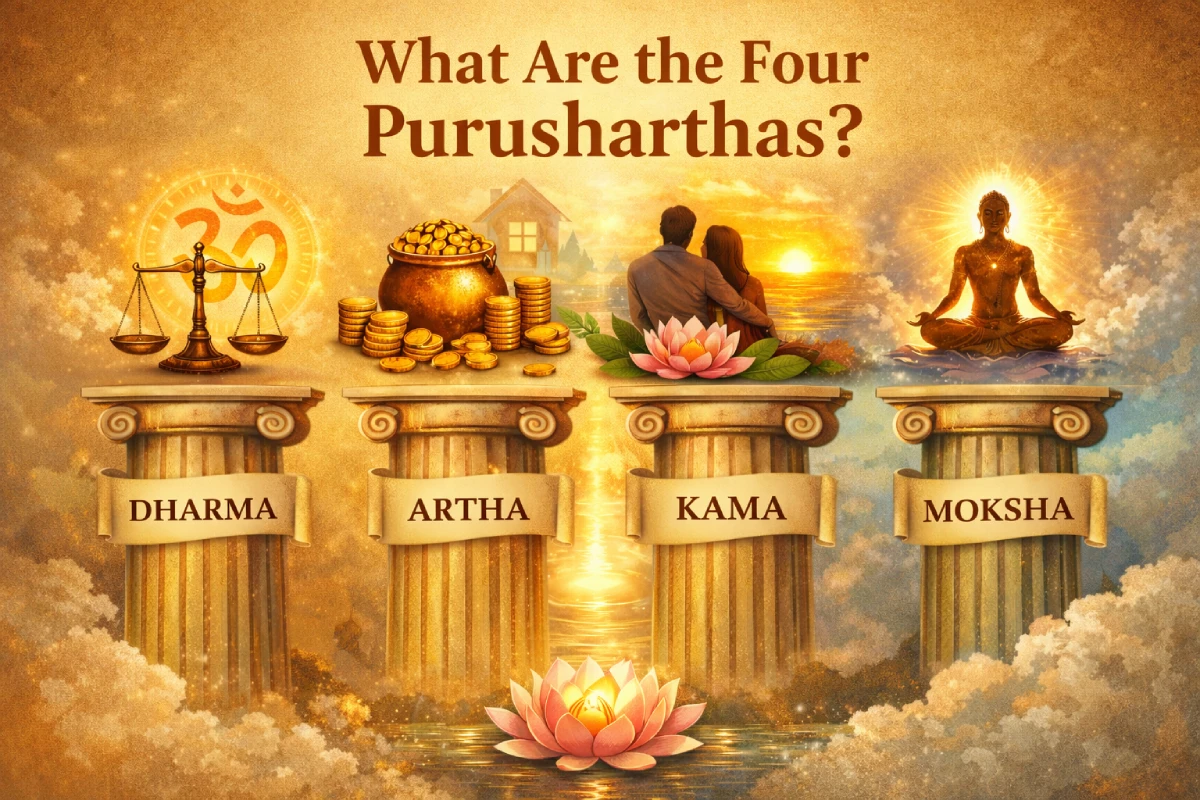
Sanatan Dharma is not limited to rituals or religious practices; it offers a complete philosophy of life that guides human beings toward balance, purpose, and fulfillment. At the heart of this life philosophy lies the concept of the Four Purusharthas.
The Purusharthas represent the four fundamental goals of human life. According to Sanatan Dharma, when a person understands and harmoniously follows these four goals, life becomes not only successful but also spiritually meaningful.
The four Purusharthas are:
Dharma, Artha, Kama, and Moksha.
Meaning of the Word “Purushartha”
The word Purushartha is derived from two Sanskrit words:
-
- Purusha – a conscious human being
- Artha – goal or objective
Thus, Purushartha means the goals that a human being consciously strives for in life.
These goals define what to pursue in life and how to pursue it.
1. Dharma – The Moral Foundation of Life
Meaning of Dharma
The word Dharma comes from the Sanskrit root “Dhṛ”, which means to sustain or uphold.
Dharma is that principle which maintains harmony and balance in individual life, society, and nature.
Dharma does not mean religion alone. It includes:
-
- Truthfulness
- Non-violence
- Compassion
- Duty
- Ethical conduct
Importance of Dharma
Dharma:
-
- Gives direction to life
- Helps distinguish right from wrong
- Purifies actions
Without Dharma, Artha (wealth) and Kama (pleasure) can become destructive. Therefore, Dharma is considered the foundation of all Purusharthas.
2. Artha – Material Stability and Prosperity
Meaning of Artha
Artha refers to wealth, resources, and material well-being.
Sanatan Dharma does not reject material life; instead, it teaches that wealth should be earned righteously.
Artha includes:
-
- Livelihood
- Property
- Social security
- Necessary comforts of life
Role of Artha
The purpose of Artha is:
-
- Supporting family and society
- Enabling charity and righteous actions
- Living a dignified life
When Artha is guided by Dharma, it benefits both the individual and society. Without Dharma, wealth often leads to greed and suffering.
3. Kama – Desire, Pleasure, and Emotional Fulfillment
Meaning of Kama
Kama does not mean uncontrolled lust. It represents:
-
- Desires
- Love and affection
- Aesthetic enjoyment
- Emotional satisfaction
Sanatan Dharma accepts human desires but emphasizes moderation and balance.
Importance of Kama
Kama:
-
- Adds joy and motivation to life
- Strengthens relationships
- Makes life meaningful and emotionally rich
However, when Kama exceeds the limits of Dharma and Artha, it leads to attachment and suffering.
4. Moksha – The Ultimate Goal of Life
Meaning of Moksha
Moksha means liberation—freedom from:
-
- The cycle of birth and death
- Ignorance
- Ego and attachment
Moksha is not a physical place; it is a state of consciousness where the soul realizes its true nature.
Importance of Moksha
In Moksha:
-
- The soul realizes its unity with Brahman
- Fear, sorrow, and dissatisfaction end
- Eternal peace is attained
Among the four Purusharthas, Moksha is considered the highest goal.
Relationship Between the Four Purusharthas
The four Purusharthas are not separate or conflicting goals. They are interconnected and complementary:
-
- Dharma provides guidance
- Artha provides stability
- Kama provides joy
- Moksha provides ultimate freedom
If a person pursues Artha and Kama without Dharma and Moksha, life becomes imbalanced and restless.
Four Purusharthas in Daily Life
In Personal Life
-
- Dharma → honesty and responsibility
- Artha → ethical livelihood
- Kama → balanced desires
- Moksha → self-reflection
In Family and Society
The Purusharthas help a person become:
-
- A responsible family member
- A moral citizen
- A spiritually aware individual
Relevance of the Four Purusharthas in Modern Life
Modern life is filled with:
-
- Stress
- Competition
- Dissatisfaction
The Four Purusharthas teach:
-
- Balance instead of excess
- Purpose instead of confusion
- Long-term happiness instead of temporary pleasure
This is why the concept remains timeless and practical.
The Purusharthas and the Sanatan Way of Life
Sanatan Dharma does not ask people to abandon the world. It teaches:
-
- Live in the world
- Perform duties responsibly
- Enjoy life with moderation
- Ultimately move toward liberation
This balanced vision is the essence of the Four Purusharthas.
Conclusion
The Four Purusharthas form the backbone of Sanatan Dharma’s life philosophy.
Dharma guides life, Artha sustains it, Kama enriches it, and Moksha completes it.
A person who follows these four goals in harmony lives a life that is:
-
- Ethical
- Prosperous
- Joyful
- Spiritually free
This is the timeless message of the Four Purusharthas in Sanatan Dharma.